
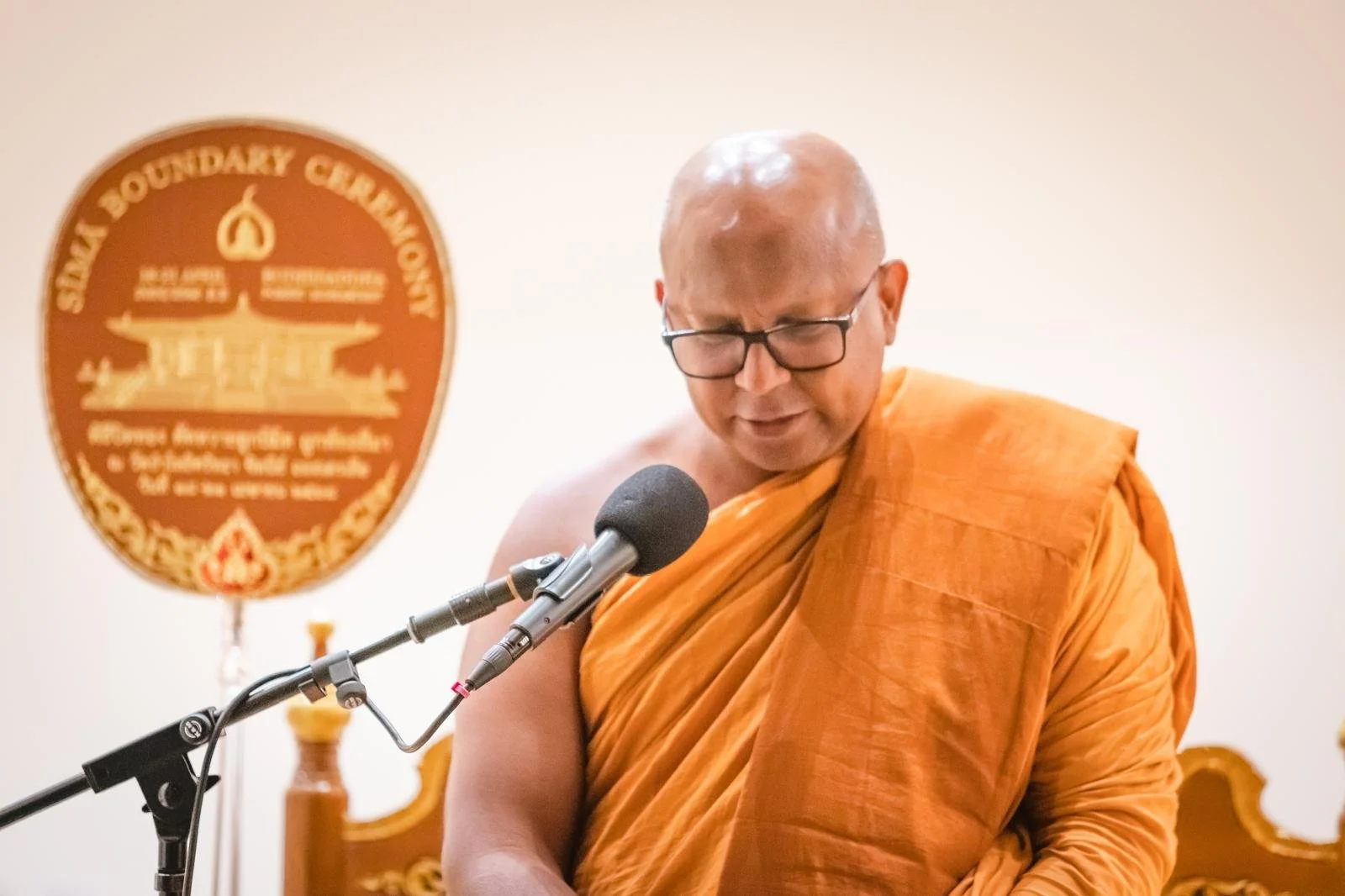
Venerable
Ajahn Visuddhananda
Abbot of Chetiya Mandapa Meditation Centre
The Autobiography of Ajahn Visuddhananda
Early Life
I was born in Sri Lanka, in a town called Hikkaduwa in the coastal region of Southern Sri Lanka. During my university education, I had many opportunities to study and work with coral reefs, dolphins, whales, forests, and mangrove ecosystems, including involvement in environmental conservation. However, during the El Niño event of 1996, many coral reefs around the world were destroyed, including the reefs around Sri Lanka that I had studied.
Around that time, I encountered the Dhamma teachings of the Venerable Gangodawila Soma Thero and pursued the study of quantum mechanics during the final year of my university studies. Both of these led to a profound inner transformation that deeply influenced the rest of my life.
Ordination & Early Training
After that, I decided to ordain as a monk under Venerable Nāvana Ariyadhamma Mahāthera. Venerable Ariyananda Thero of Angulgamuwa gave me my initial meditation instructions.
My first rains retreat was spent at Nā Uyana Monastery. During my second rains retreat, Venerable Ariyananda Thero sent me to Burma, where I received meditation training under the Venerable Pa-Auk Sayadaw. After returning to Sri Lanka, I visited many respected meditation masters throughout the country and continued my training in the practice of the Dhamma.
Walking Pilgrimages
For many years following the completion of my first rains retreat, I undertook walking pilgrimages, including one from Nā Uyana to the Ruwanwelisaya Stupa. Sometimes I walked nearly one hundred kilometres over several days. I would stay in forests and remote places, living a wandering life after each rains retreat. In this way, I continued to train and develop in the monastic life.
Training In Thailand
During this period of meditation practice, I met Ajahn Brahmavamso. When I told him about my experiences as a monk, he encouraged me to travel to Wat Marp Jan in Thailand. The journey there was quite difficult, but I eventually made it.
However, I was first sent to Wat Pah Nanachat, the international forest monastery founded by Venerable Ajahn Chah. Within a few days of entering Wat Pah Nanachat in Thailand, I began to feel as though I had fallen into a river. It was like being carried along by a steady current. I gradually realized that I had entered a well-organized and systematic training tradition. It was not like the things I had gathered here and there on my own in Sri Lanka. Rather, everything formed part of a complete and carefully structured system of training.
Practices that I had previously tried to maintain on my own—such as going on almsround, eating only one meal a day, living in seclusion, and going on wandering pilgrimage after the Rains Retreat—were all observed there as established traditions within the monastic community. Additionally, every fifteen days the fully ordained monks gathered together to recite the Pātimokkha. Observing these practices, I could clearly see how the entire system supported and strengthened the mind.
I was especially struck by the harmony of the Sangha, the respect shown to the elders, the willingness to support one another, and the spirit of kindness, compassion, and brotherhood that existed among them. This left a deep and lasting impression on my heart. All these qualities and practices followed closely to the Buddha’s instructions. In addition, it was clear to me that this tradition was firmly practicing in line with the Buddha’s teachings on the importance of developing patience and endurance.
After completing an initial period of training there, the abbot eventually sent me to Wat Marp Jan, where I continued my meditation training under my teacher, Venerable Ajahn Anan.
All of these experiences with the Ajahn Chah Sangha were a major reason for the thought to arise in my mind that the Thai Forest Tradition should one day be established in Sri Lanka.
At that time, however, I did not believe that great arahant monks were still living in Thailand. This was a mistaken view on my part, as we had not grown up in an environment where such an understanding could easily arise. Later, when I stayed in Thailand with my teacher at Wat Marp Jan and lived and practiced among the monks there, I gradually came to see that my earlier view had been wrong. From that noble Saṅgha I experienced such profound loving-kindness, and many other noble qualities. This too became an important reason why the aspiration arose in my heart to establish the Thai Forest Tradition in Sri Lanka.
From Master to Master
From the beginning of my monastic training, I understood that the monastic life could be like an alms-round, wandering from house to house seeking food. Since the Buddha is no longer physically present in the world, I felt it was important to travel from place to place, meeting different meditation masters and gathering their experiences and teachings into my own life—just as a monk collects alms.
Eventually, after gathering these experiences, I felt that the time had come to settle down in one place. It felt similar to a monk collecting food on alms-round and then sitting peacefully beside a river to eat his meal. In the same way, I felt that I should take all the training I had gathered and practice it deeply in a quiet place. In this way, the aspiration I had formed in my early years gradually came to fulfillment.
A Secluded Life at Thotupola Hermitage
After receiving training from Venerable Ajahn Anan in Thailand, I returned to Sri Lanka and began living a very austere life on an island in the Bolgoda River in Panadura. From there, I would travel by boat to the village for alms round and then return to the island to continue my meditation practice.
After living on the island for six months, I realized that it was a deeply secluded place, suitable for monks to develop their practice. With this understanding, Thotupola Hermitage gradually became established. While living there, I came to deeply understand Ajahn Chah’s repeated teachings on the use of methods of self-torture for making swift progress on the path.
Establishing Chetiya Mandapa
In 2022, I came to know of a special property in Anuradhapura. On one side of the land was a lake known as Bandara Balunkulama, and on the other side stretched a large paddy field. Beyond the paddy field stood three of the most revered chedis in all of Sri Lanka, venerated throughout the Buddhist world. Facing the paddy field, one could see—from right to left—Ruwanweli Chedi, Jetavana Chedi, and Abhayagiri Chedi. From an elevation of about thirty feet, two additional great chedis became visible: Mirisavetiya Chedi and Sandahiru Seya Chedi.
I realized how much saddhā (faith and conviction) naturally arises when meditating in such a place. Through my own practice, I came to understand that this was a deeply auspicious land.
After about eleven years living at the hermitage, Luang Por Anan suggested that I spend the rains retreat at that new property in Anuradhapura. In order to fulfill one of my deepest aspirations—to firmly establish the Thai Forest Tradition in Sri Lanka—I humbly requested Luang Por to assist in developing a branch monastery of Wat Marp Jan at this new location. In this way, Chetiya Mandapa Meditation Centre was established as an official branch monastery of Wat Marp Jan in January 2023.